Saros Review: A Stronger, Smarter Return to the Fight
Saros Review: Housemarque Evolves the Returnal Formula Into a Stunning Sci-Fi Roguelite
Saros is a sci-fi roguelite third-person shooter from Housemarque that immediately invites comparisons to Returnal. Both games feature fast movement, hostile alien worlds, bullet-heavy combat, mysterious storytelling, and a protagonist trapped in circumstances they do not fully understand. But Saros is not simply Returnal with a new planet and a new lead character. It takes Housemarque’s familiar formula and reshapes it into something more flexible, more approachable, and in many ways more emotionally direct.
Where many roguelites define a run as a full restart from the beginning, Saros takes a broader approach. It still has procedural elements, dangerous combat encounters, valuable pickups, and the risk of failure. However, it also gives players more permanent progression, more control over where they go, and a stronger feeling that each attempt pushes the larger story forward. The result is a roguelite that keeps the tension of the genre while reducing some of the repetition that can make similar games feel exhausting.
Saros succeeds because it combines intense combat with a haunting world, a compelling mystery, and a protagonist whose personal mission gives the action emotional weight. It is challenging, stylish, and deeply atmospheric, but it also feels carefully designed to keep players engaged rather than punished.
A Mysterious Mission on the Planet Carcosa
Saros begins with very little explanation. Communication has been lost with the colony ships Echelon I, II, and III on the planet Carcosa. A fourth ship, Echelon IV, is sent to investigate. The emergency crew includes engineers, command staff, and armed Enforcers assigned to protect the mission.
Players take control of Arjun Devraj, one of those Enforcers. By the time the game begins, the mission has already gone terribly wrong. Thousands of colonists are missing, members of the crew are breaking down mentally, and Arjun discovers that death may not be permanent for him. Like the player, he is thrown into a nightmare with more questions than answers.
The planet Carcosa is central to the game’s unsettling tone. The name itself carries literary and horror associations, and Saros uses that history to create a place that feels ancient, cursed, and hostile. This is not a traditional horror game, but it often feels deeply uncomfortable. The planet seems alive in ways that are hard to understand, and every new discovery makes the mission feel more dangerous.
Corporate Greed Drives the Story
The Echelon program exists because of Lucenite, a powerful compound found on Carcosa with enormous energy potential. The Soltari corporation sees Lucenite as a trillion-dollar opportunity, and that corporate hunger creates much of the game’s conflict.
Soltari is the kind of science-fiction company that values profit over people. The missing colonists, the collapsing mission, and the dangers of Carcosa all connect back to the company’s obsession with extraction and control. This gives Saros a familiar but effective corporate-horror foundation.
Arjun’s motivation is more personal. He is not only there as a soldier or company operative. Someone important to him was aboard Echelon I, and that connection gives his mission urgency. The “searching for a loved one” setup could have felt predictable, but Saros uses it well. Arjun’s journey becomes darker and more complicated as the truth unfolds, and his personal struggle gradually merges with the larger mysteries of Carcosa.
Arjun Is a Stronger Protagonist Than Expected
Arjun’s story works because the game gives him room to grow. He begins as a determined, capable Enforcer, but his emotional state becomes more layered as the mission continues. His anger, grief, confusion, and obsession all shape how he reacts to Carcosa and the people around him.
The voice acting helps carry that emotional weight. Arjun’s performance gives the character a sense of pain and determination that makes his personal mission feel believable. The supporting cast also adds depth, even when some characters are only heard through audio logs or brief conversations in the hub.
The only weakness in the presentation is that some in-game character models do not fully match the strength of the voice performances. During major emotional scenes, the facial animation can occasionally feel stiff. It is not enough to damage the story, but it does stand out when the writing and acting are otherwise strong.
Carcosa Is a Beautiful and Terrifying World
The world design in Saros is one of its greatest strengths. Each biome on Carcosa has a distinct visual identity, but all of them contribute to the same feeling of unease. The planet is beautiful, hostile, and deeply wrong.
Some areas feature white marble architecture filled with statues and disturbing art. Others descend into industrial spaces full of pipes, machinery, fire, and biomechanical imagery. A ruined city creates tight firefights in narrow streets, while swamp areas force players to deal with toxic water and dangerous environmental shifts.
The art direction mixes ancient alien mystery with corporate sci-fi and body-horror influence. The result is a world that feels layered and unknowable. Carcosa does not simply look like a hostile planet; it feels like a place with a terrible history buried beneath every structure.
Environmental storytelling plays a major role. Logs, images, and strange events gradually reveal more about the mission, the planet, and the forces at work. Saros rarely gives players complete answers immediately. Instead, it feeds information slowly, keeping the mystery alive across runs.
Combat Feels Like a Bullet Ballet
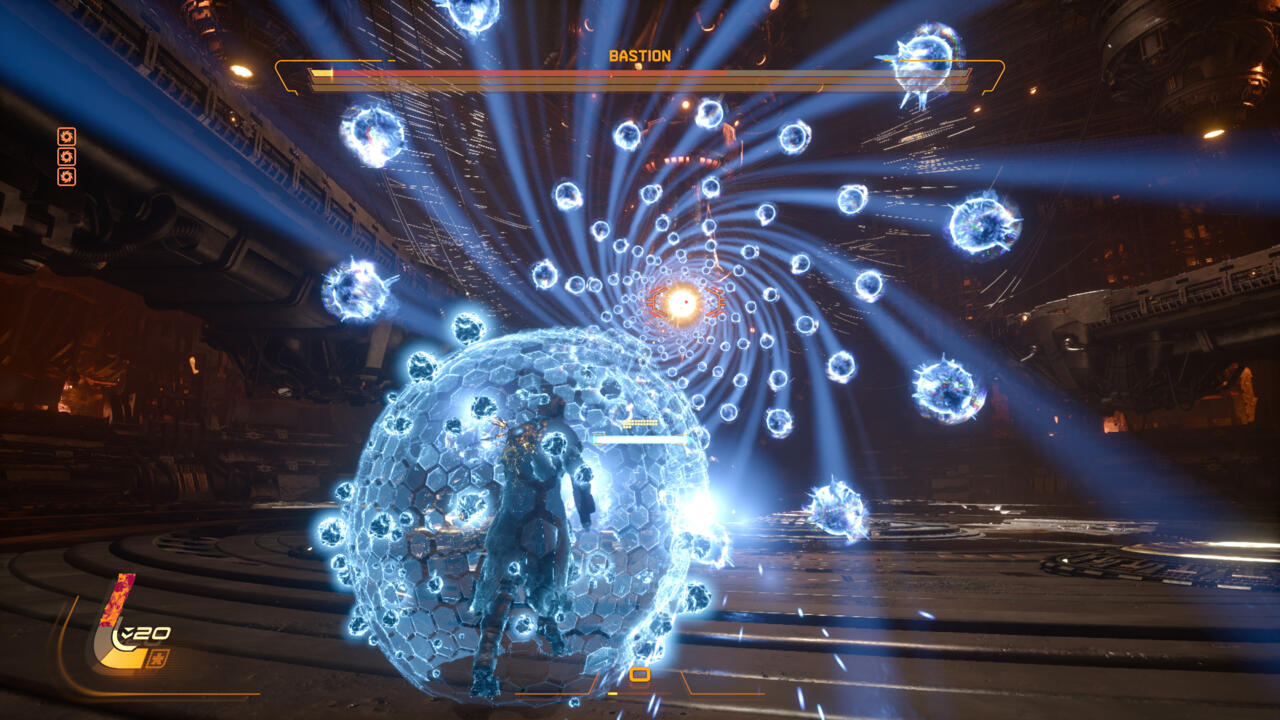
Combat is where Saros truly shines. Like Returnal, it is built around fast third-person shooting, movement, and waves of glowing projectiles. But Saros changes the rhythm by giving Arjun a more aggressive defensive tool: a shield that can absorb certain attacks and convert that energy into Power.
This shield system changes how players think about enemy fire. Blue projectiles can be dashed through or absorbed. Yellow projectiles can be dashed through but damage the shield quickly. Red projectiles must be avoided until later upgrades give players more ways to respond. This color-coded system keeps combat readable even when the screen fills with bullets, beams, and explosions.
The result is not pure bullet hell. It feels more like a dangerous dance. Players weave through danger, absorb the right attacks, avoid the wrong ones, fire back, reload, use melee strikes, and unleash Power attacks when the moment is right. The best fights create a flow state where every movement feels deliberate.
This rhythm is one of the most satisfying parts of Saros. Combat is intense without feeling unfair. Mistakes are punished, but the rules are clear. When you die, you usually understand what went wrong.
Weapons Feel Powerful and Varied
Saros includes several weapon types, including rifles, shotguns, pistols, crossbows, and other sci-fi firearms. Each weapon type can appear with different modifiers, firing patterns, and alternate fire modes. One pistol might fire in bursts, while another might ricochet rounds between enemies. A shotgun might have a tighter vertical spread, while a crossbow might fire additional homing projectiles.
This variety keeps runs interesting without making success feel entirely dependent on luck. Most weapons feel viable, and each has enough personality to make experimentation worthwhile. The game does not require one perfect weapon to survive. Instead, it encourages players to adapt to whatever tools they find.
Artifacts add another layer of customization. These items grant passive bonuses or special effects, such as generating Power automatically or reducing incoming damage. Since there is a limit to how many Artifacts can be equipped, players must make choices about which build direction matters most.
Permanent Progression Makes Saros More Flexible
One of the biggest improvements Saros makes to the roguelite formula is its permanent upgrade system. Players collect Lucenite during runs and spend it at the hub to unlock upgrades from a large skill tree.
Some upgrades improve basic attributes like armor, maximum Power, or survivability. Others change the way runs begin, such as adding Artifact slots, providing keys at the start, increasing Lucenite drops, or improving weapon proficiency earlier in a run.
This system gives players a strong sense of progress. Even failed runs usually provide resources that make the next attempt easier or more interesting. Instead of feeling like you are starting from nothing, you gradually build Arjun into a more capable fighter.
Saros also avoids one of the biggest frustrations in many roguelites: forcing players to restart from the beginning every time. Once a biome is unlocked, players can return to it directly from the hub. This gives the game a more flexible structure and reduces repetition. You can still replay earlier areas if you want to gather resources, but the game does not constantly force you to repeat content before reaching your current objective.
A Roguelite That Respects Player Time
This structure makes Saros feel more respectful of the player’s time than many similar games. It keeps the excitement of procedural runs, but it also gives you control over pacing. You can push forward, revisit older areas, farm upgrades, or focus on a specific biome.
That flexibility does not make the game easy. Saros is still demanding. Bosses are intense, enemy waves can overwhelm careless players, and later biomes require strong positioning and quick reactions. However, the game rarely feels like it is wasting your time. Progression is steady, and the permanent upgrade tree ensures that effort usually matters.
Final Verdict: Saros Is a Must-Play Sci-Fi Roguelite
Saros is a fantastic evolution of Housemarque’s sci-fi shooter formula. It captures the fast, dangerous, bullet-heavy combat that made Returnal memorable while adding stronger progression, more flexible structure, and a gripping emotional story.
Arjun’s journey gives the game a compelling human center, while Carcosa provides a mysterious and visually unforgettable setting. The combat is thrilling, the weapons feel excellent, and the shield-based Power system adds a smart twist to the usual dodge-and-shoot rhythm.
Some character animations fall short of the excellent voice acting, but that is a minor issue in an otherwise impressive package. Saros is challenging, atmospheric, and mechanically rich. For fans of Returnal, roguelites, sci-fi shooters, or intense third-person action games, it should not be missed.
Saros FAQ
What kind of game is Saros?
Saros is a sci-fi third-person roguelite shooter with fast movement, bullet-heavy combat, permanent upgrades, procedural biomes, and a strong narrative focus.
Is Saros similar to Returnal?
Yes. Saros shares similarities with Returnal, including sci-fi themes, third-person shooting, and bullet-heavy combat, but it adds a more flexible run structure and stronger permanent progression.
Who is the main character in Saros?
The main character is Arjun Devraj, an Enforcer sent to investigate the missing Echelon colony ships on the alien planet Carcosa.
Does Saros have permanent upgrades?
Yes. Players collect Lucenite and spend it at the hub to unlock permanent upgrades, including stronger armor, more Power, extra Artifact slots, better drops, and improved run-starting options.
Is Saros worth playing?
Yes. Saros is worth playing for fans of Housemarque games, Returnal-style action, sci-fi roguelites, intense third-person shooters, and atmospheric mystery-driven storytelling.